Why this matters
Most businesses treat probation as a box to tick. Everyone gets busy, the date passes, and the new hire is now permanent, whether they are working out or not.
Others make the opposite mistake. Labour lawyer Aslam Moolla described a common belief in Independent Online in February 2026: "Don't worry, he's only been here for two weeks. He's on probation. We can just tell him it's not working out and let him go today." That is not how it works. Someone on probation is still an employee, with the same basic protection against unfair dismissal as everyone else.
Here is the good news. Since September 2025, the rules make it easier to fix a hiring mistake during probation. The catch is that you still have to follow a fair process. Skip it, and you can still end up paying for an unfair dismissal claim.
What changed in 2025
On 4 September 2025, a new Code of Good Practice: Dismissal came into effect. It is the official guide used to decide whether a dismissal was fair. Two changes matter for anyone who hires:
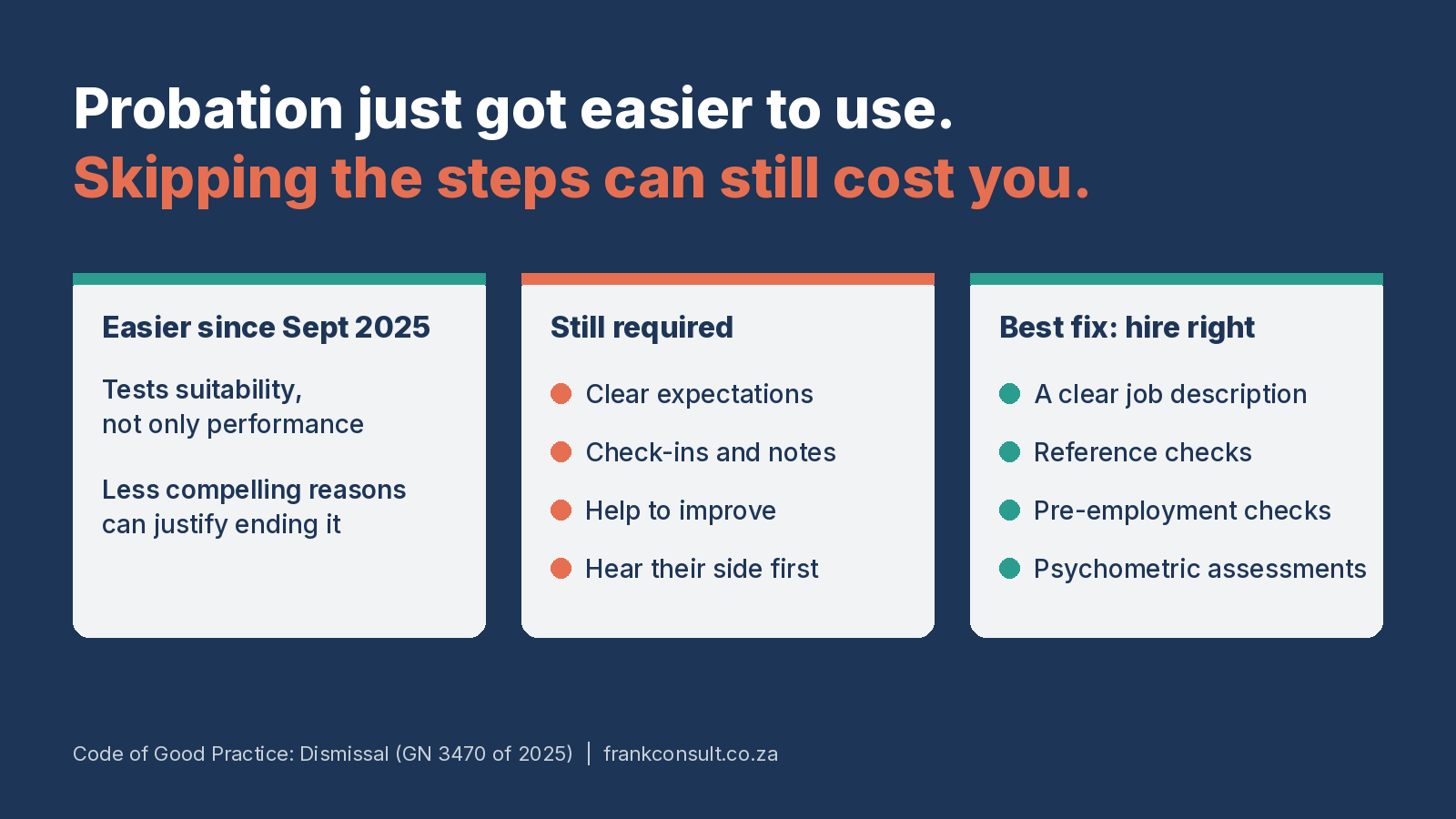
- Probation now covers fit, not just performance. It also tests whether the person is suitable for the role, which legal commentators read as including how they fit in and behave at work.
- You need a less serious reason to let someone go during probation. If the problem is their conduct (how they behave) or their capacity (their ability to do the job), a reason that might not be enough after probation can be enough during it.
In simple terms, if you have hired the wrong person, probation is the easiest and cheapest time to deal with it. That window is wider than many employers realise.
The catch: you still need a fair process
The rules make it easier to justify the decision. They do not let you skip the steps. You still need to:
- Tell the person what "good" looks like. They must know what is expected of them, ideally in writing.
- Help them get there. Give reasonable training, guidance or coaching. "We assumed they would figure it out" will not hold up.
- Hear their side before you decide. Before you end their employment or extend their probation, they must get a proper chance to respond to your concerns. Lawyers call this making "representations". You must actually consider what they say.
A recent warning from the Labour Court
On 6 November 2026, the Labour Court in Cape Town decided Moodley v South African Local Bargaining Council Western Cape & others (case no. C439/2024). The City of Cape Town had put a new employee on six months' probation, extended it by two months, and then ended her appointment.
The Court agreed that a lower bar applies during probation. It still overturned the earlier ruling in the employer's favour and sent the case back to be heard again. Nobody had properly checked three things: whether the standard she was measured against had been agreed and explained to her, whether the two-month extension gave her a real chance to improve, and whether her side of the story had genuinely been considered.
The dismissal happened in 2023, under the old rules, but the lesson stands: an easier test does not excuse a sloppy process.
The best fix happens before day one
The easiest probation problem to solve is the one you never have. A careful hiring process makes it far more likely that the person you choose is right for the role.
Three checks make a real difference:
- Reference checks. Speak to previous managers and ask specific questions about the work the person did and how they handled pressure.
- Pre-employment checks. Confirm qualifications and work history are genuine. Where the job justifies it, such as roles handling money or sensitive information, criminal or credit checks may also be appropriate.
- Psychometric assessments. Good tests measure cognitive ability (how quickly someone learns and solves problems) and suitability (working style, personality and fit with the role). They add an objective view to what you hear in an interview.
These checks must be fair and relevant to the job. Candidates should know what is being checked and give their consent, and their personal information must be handled in line with the Protection of Personal Information Act (POPIA). Under the Employment Equity Act, psychological tests may only be used if they are scientifically shown to be valid and reliable, can be applied fairly to everyone, and are not biased against any person or group.
This is where a reliable, trustworthy recruitment partner earns its fee. A good partner manages the whole hiring process for you, from shaping the job description to references, checks and assessments, and takes responsibility for putting the right person in the role. That means fewer surprises during probation and far less risk of a costly mistake.
Your probation checklist
- Start with a well-defined job description. Be clear about what the role involves and what success looks like, then write down three to five things the person must achieve or show and share them in week one.
- Book check-ins when you sign the offer. Diarise reviews at about 30, 60 and 90 days, plus a final review at least two weeks before probation ends, and write a short note after each one.
- Raise concerns early and clearly, not in the final week.
- Extend properly, or not at all. If you extend, give clear reasons, a new end date and a realistic plan to improve.
- Make an active decision. Confirm, extend or start a fair process. Never let the date slip by.
- Know the notice period. Under the Basic Conditions of Employment Act, notice in the first six months of employment is one week.
- Check your contracts, and get labour law advice before any specific dismissal.
The takeaway
The 2025 rules give employers a real chance to correct a hiring mistake early. But that chance belongs to businesses that hire carefully and run probation properly. Set clear expectations, support the person, keep notes and hear them out before you decide.
Sources: Department of Employment and Labour, Code of Good Practice: Dismissal (GN 3470 of 2025, effective 4 September 2025), with commentary from Cliffe Dekker Hofmeyr, DLA Piper Africa and Lex Africa; Moodley v South African Local Bargaining Council Western Cape & others, Labour Court, Cape Town, 6 November 2026, case no. C439/2024, as summarised by AJ Nel; Aslam Moolla, Independent Online, 16 February 2026; Employment Equity Act, section 8; Protection of Personal Information Act; Basic Conditions of Employment Act, section 37. This article is general information, not legal advice.